Feedback Loops
Reinforcing and balancing loops drive growth and stability (Meadows).
Author
Systems thinking (Norbert Wiener, Jay Forrester, Donella Meadows)
Model type
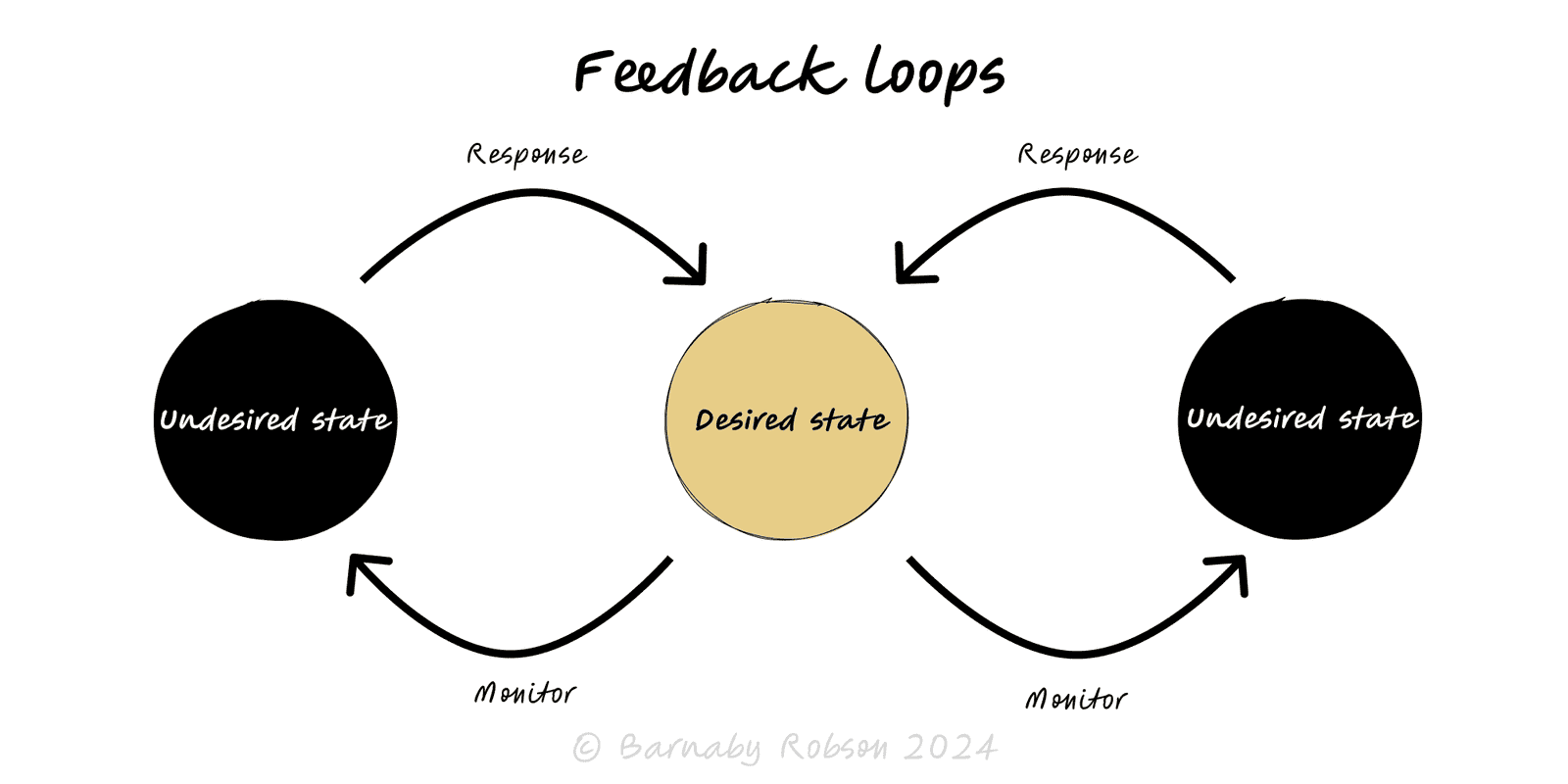

Reinforcing and balancing loops drive growth and stability (Meadows).
Systems thinking (Norbert Wiener, Jay Forrester, Donella Meadows)
A feedback loop occurs when outputs of a system influence its future inputs. Two core types govern behaviour: reinforcing (positive) loops that accelerate change (growth or collapse) and balancing (negative) loops that stabilise around a target. Because loops interact and often include delays, systems can overshoot, oscillate, or tip into runaway outcomes. Mapping loops makes complex behaviour legible and steerable.
Reinforcing (R) loops – “the more you have, the more you get” (compounding users → more content → more users). Left unchecked, they tend towards exponential growth or free-fall.
Balancing (B) loops – push towards a goal or constraint (thermostat, inventory reorder rules).
Delays – perception, approval, shipping or learning lags make control sluggish and cause overshoot.
Limits & saturation – carrying capacity, budgets, attention; R loops flatten into S-curves.
Cascades & tipping points – multiple R loops can reinforce each other; small changes flip regimes.
Representations – causal loop diagrams (CLDs: arrows with +/−), and stock–flow models (levels, inflows, outflows).
Product & growth – acquisition ↔ engagement ↔ referrals; abuse/spam feedback; creator or marketplace flywheels.
Operations & supply chains – WIP ↔ wait times; reorder rules; bullwhip effects.
Reliability – incidents ↔ load ↔ retries; rate limits and circuit breakers as balancing loops.
Finance & risk – leverage ↔ asset prices; liquidity spirals; risk controls as dampers.
People & performance – coaching ↔ competence ↔ autonomy; burnout spirals and recovery loops.
Policy – congestion pricing, public health R<1 targets, housing supply vs price.
Define the outcome (“stock”) – e.g., active users, cash, backlog, error rate.
Map drivers – sketch a CLD with key variables and +/− links; mark R and B loops explicitly.
Find delays & limits – where are perception/approval/production lags? what hard caps exist?
Locate leverage points – targets/thresholds, gain on controllers (how strongly B loops act), friction on harmful R loops.
Design interventions
Strengthen B loops that enforce goals (SLOs, rate limits, reorder points with buffers).
Grease helpful R loops (referrals, learning, content creation) until you near constraints.
Insert dampers (queues, quotas, circuit breakers) to prevent oscillation or runaway.
Instrument – track leading indicators for loop strength (e.g., referral k-factor, WIP, utilisation, retry rates).
Test & tune – run safe-to-fail changes; watch for new oscillations after parameter tweaks.
Revisit periodically – loops drift as context, tech and incentives change.
Linear thinking – treating curved dynamics as straight lines; ignore loops and you mis-forecast.
Delay blindness – fast corrections to slow systems cause whiplash; lengthen review windows or add buffers.
Over-tight control – aggressive B-loop gains create oscillation; tune gently.
Goodhart’s law – a target becomes the game; pair outcome and counter-metric loops.
Unbounded R loops – engagement hacks that later harm trust, quality or safety.
Local fixes, global harm – improving a part (e.g., pushing work forward) inflates queues elsewhere.
Click below to learn other mental models
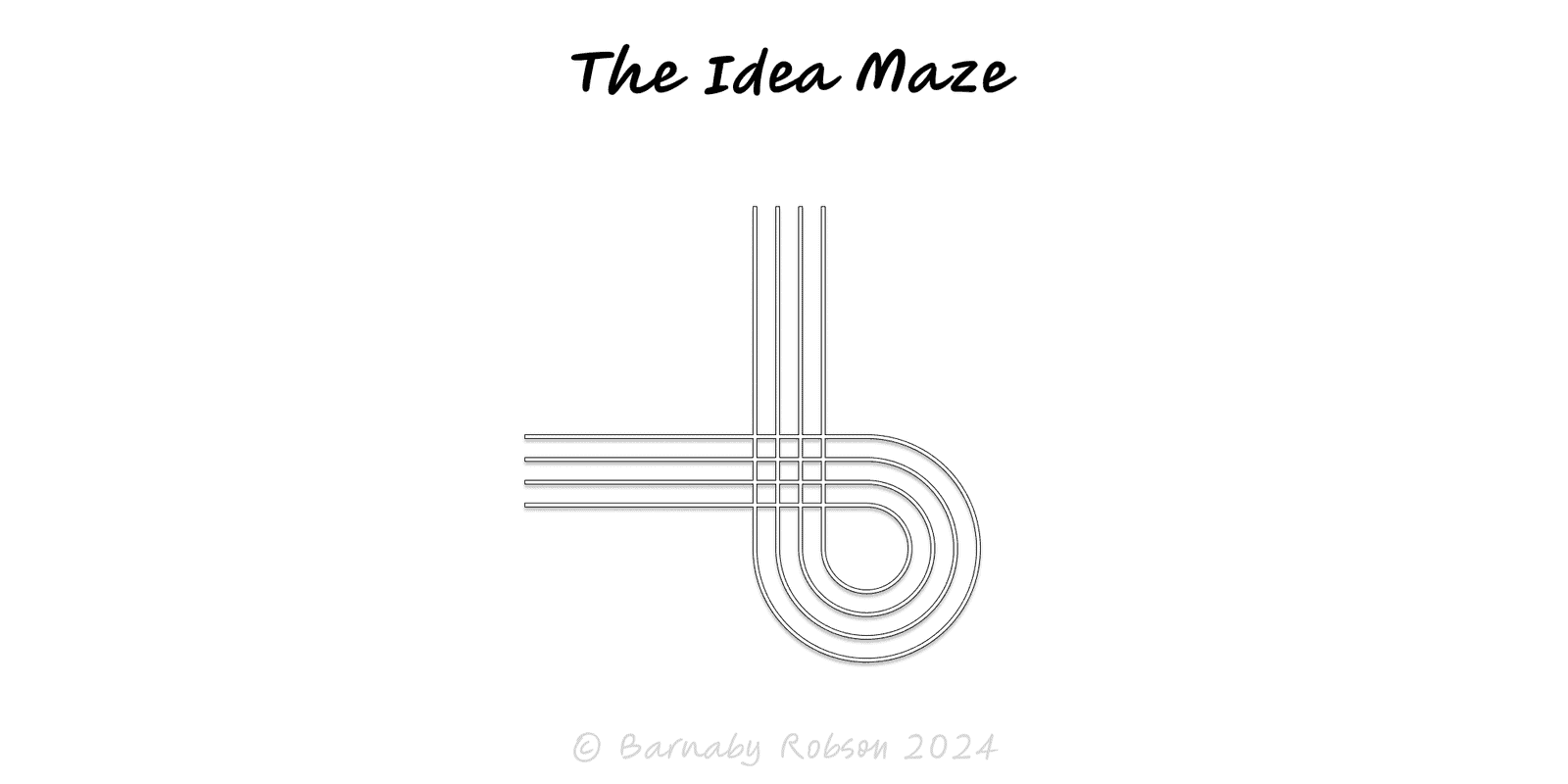
Before building, map the space: the key forks, dead ends and dependencies—so you can choose a promising path and run smarter tests.
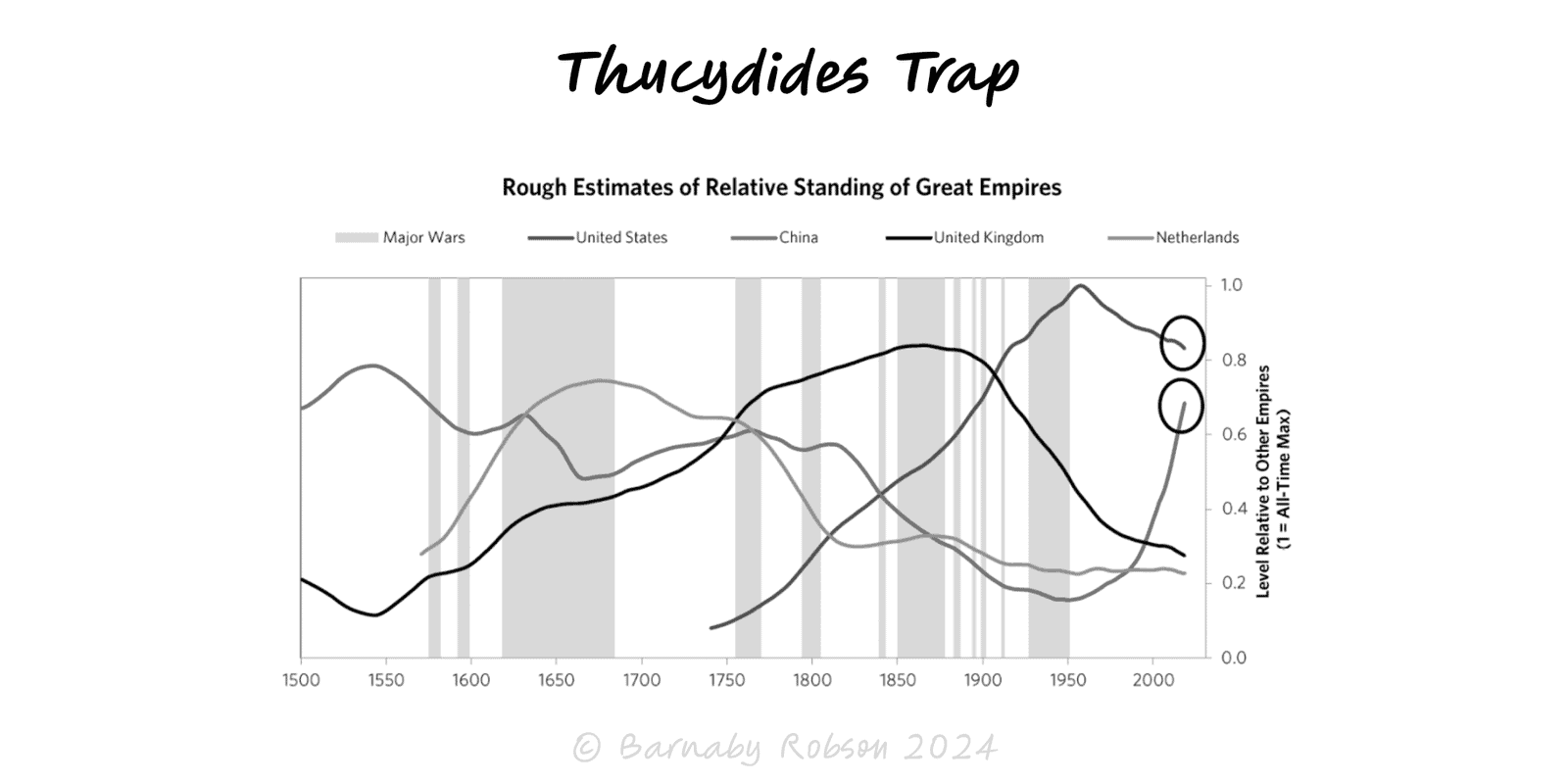
When a rising power threatens to displace a ruling power, fear and miscalculation can tip competition into conflict unless incentives and guardrails are redesigned.
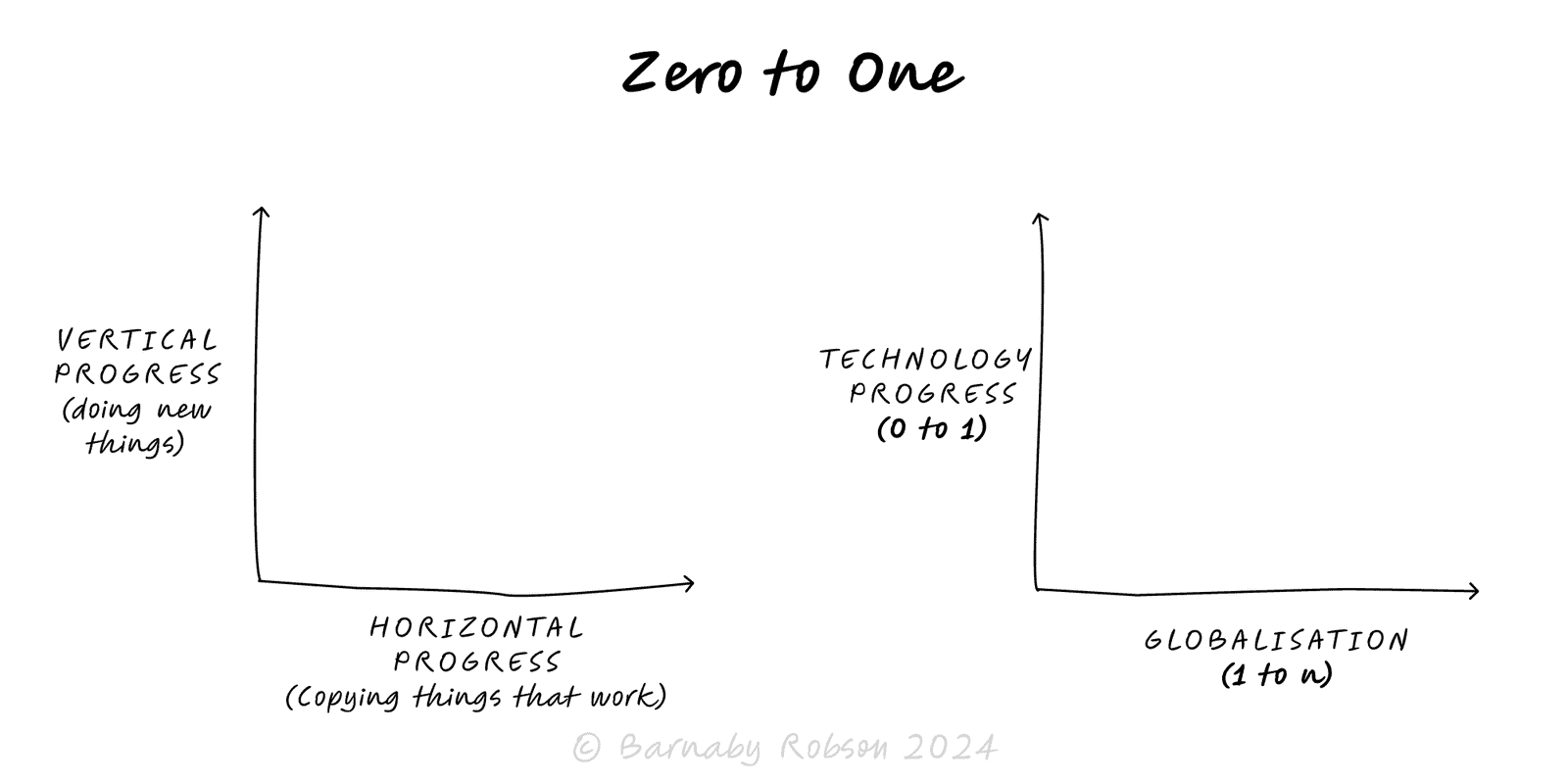
Aim for vertical progress—create something truly new (0 → 1), not just more of the same (1 → n). Win by building a monopoly on a focused niche and compounding from there.