About This Article: Like other entries in my Notes from the Book series, I wrote this primarily for myself. These notes serve as an online journal, where writing helps me learn and publishing sharpens my thoughts while creating an accessible reference. Expect longer quotations, drawn directly from my Kindle highlights, as I aim to capture key insights. Learn more about my workflow for syncing these notes here.
Introduction to Breakneck
I think the most consequential book of 2025 will be Breakneck by Dan Wang. It’s being read across leading business and political circles in ‘the West’ and I think its framing will likely shape future policy.
I really enjoyed it. I’m a long time reader of Dan Wang – his annual letters written during his time living in China (available via his blog: https://danwang.co) were must-reads for me and many China watchers from 2017 – 2022 – as he covered underreported topics in China across trade, tech, politics, cultural trends, his travels across less well known cities and much more. He returned to the US in 2023.
Breakneck, is a forward looking view on the ongoing competition between China and the US, rooted in his experiences living in both countries.
There is a lot that I enjoyed in the book – my highlights and favourite quotes are set out below.
The inadequacy of 20th Century Labels
Dan calls out early on that the competition between China and the US is not a competition between Communism and Capitalism. I completely agree, the shibboleths we tell ourselves around what countries stand for are completely out of date. In most respects – Britain, the EU and parts of the US (e.g. New York under Mamdani) are far closer to the Communism of Marx and Lenin, than China.
“Looking at these two countries, I came to realize the inadequacy of twentieth-century labels like capitalist, socialist, or, worst of all, neoliberal. They are no longer up to the task of helping us understand the world, if they ever were.
Capitalist America intrudes upon the free market with a dense program of regulation and taxation while providing substantial (albeit imperfect) redistributive policies. Socialist China detains union organizers, levies light taxes, and provides a threadbare social safety net.”
Dan Wang
“The greatest trick that the Communist Party ever pulled off is masquerading as leftist. While Xi Jinping and the rest of the Politburo mouth Marxist pieties, the state is enacting a right-wing agenda that Western conservatives would salivate over: administering limited welfare, erecting enormous barriers to immigration, and enforcing traditional gender roles—where men have to be macho and women have to bear their children.”
Dan Wang
These observations are spot on and something which has come up in debate over the last few years, that I had been unable to articulate so clearly. I used to consider myself “progressive” and “liberal” and now shudder when i hear the terms.
“It’s a strange paradox, that the liberals are illiberal in their demand for liberality. They are exclusive in their demand for inclusivity. They are homogenous in their demand for heterogeneity. They are somehow un-diverse in their call for diversity — you can be diverse, but not diverse in your opinions and in your language and in your behaviour. And that’s a terrible pity.”
Stephen Fry
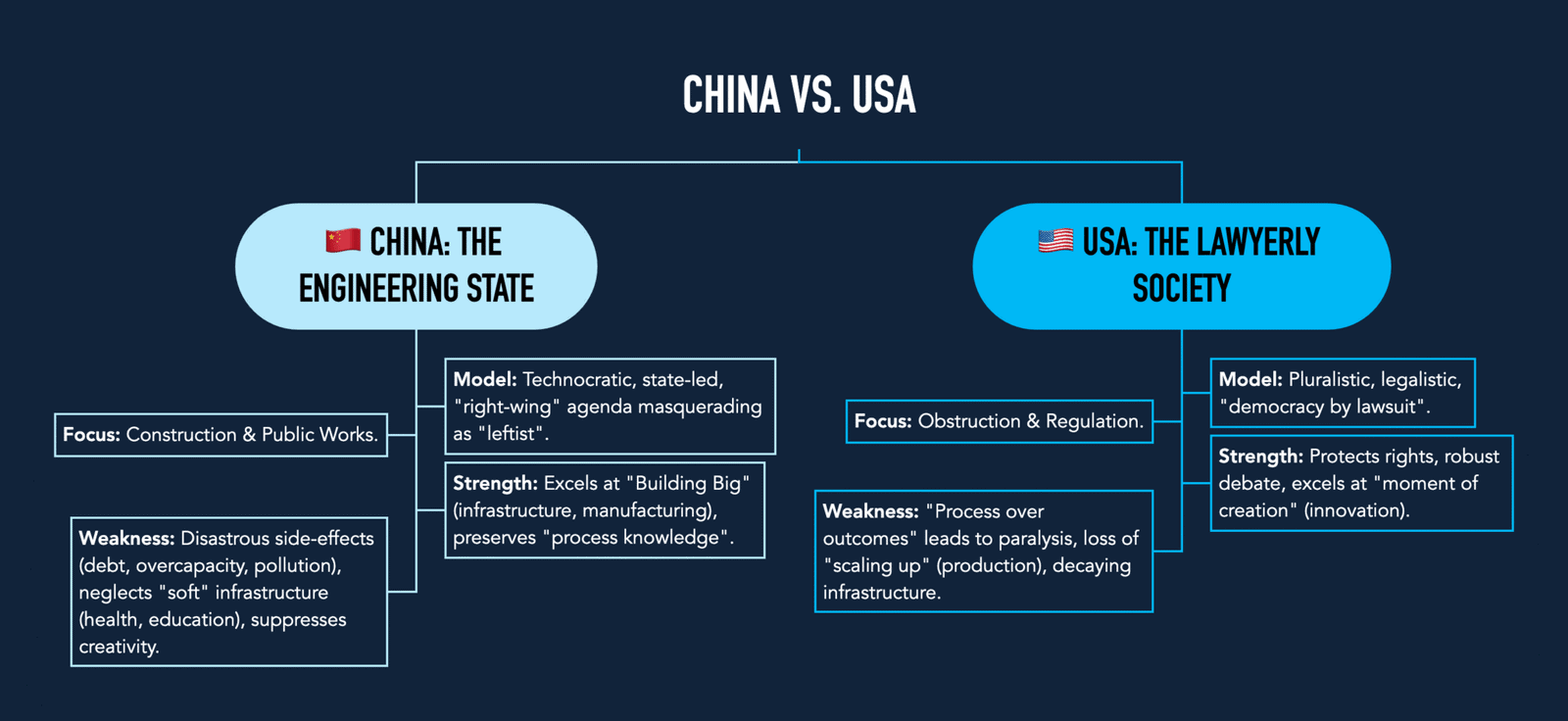
Central Theme – The Engineering Society v The Lawyerly Society
The core framing of the book is of China as an Engineering Society and the US as a Lawyerly Society. My wife contends that this is a long used concept within China which Dan has borrowed – but regardless of origins or originality – it rings very true – albeit i think the evidence shows the ultimate ‘lawyerly society’ is the European Union.
“China is an engineering state, which can’t stop itself from building, facing off against America’s lawyerly society, which blocks everything it can.”
Dan Wang
China: The Engineering State
Dan shows how China is in many ways an “Engineering State.” You can see this right in its leadership: by 2002, all nine members of the Politburo standing committee were trained as engineers.
“What do engineers like to do? Build.”
Dan Wang
The main strength here is the ability to “Build Big and Fast”. For example, China built the 800-mile Beijing-Shanghai high-speed rail in just three years and has more high-speed rail than the rest of the world combined. The Port of Shanghai alone moved more containers in 2022 than all US ports put together. China is also building 31 new nuclear plants (the US is building one). This is all supported by a massive manufacturing workforce of over 100 million people, which gives them a huge “ecosystem of technology” and preserves “process knowledge.”
The depth of this “process knowledge” and quality of infrastructure is why I don’t believe ASEAN or India or Latam have a chance of replacing the advanced manufacturing in China.
But this model also has severe problems which Dan articulates. Specifically its projects often “tend to begin impressively and end disastrously”—think of the One-Child Policy or the Zero-Covid strategy.
This approach also can create massive economic imbalances, like the enormous debt from building “dubious” infrastructure like airports in Guizhou that nobody uses. It also leads to huge overcapacity in areas like solar and autos, which kills profits and disconnects the stock market from GDP. We see this across almost all industries in China (including consulting where I work) where profit margins are wafer thin and there appears to be a race to the bottom.
Ultimately, perhaps the biggest challenge is the “state’s deadening hand” can suppress creativity – we saw this with the crack down on private industry from c. 2018 – which thankfully now appears to be being reversed.
USA: The Lawyerly Society
In contrast, the United States operates as a “Lawyerly Society.” Its leadership is dominated by lawyers, with five of the last ten presidents and at least half of Congress holding law degrees. The nation’s ideology shifted in the 1960s, as the public soured on technocrats due to environmental harm, moving the focus from building to stopping. The American social contract is focused on demand-side economics, such as rent control or pandemic cheques, and its governance model resolves political questions through the courts in a “democracy by lawsuit”.
The strengths of this system are a championing of pluralism and rights. This drives confidence and investment which is why the US retains deep advantages in innovation and digital tech.
The weaknesses of the lawyerly society, however, are profound, beginning with its obsession with “process over outcomes”
This leads to paralysis and “decaying infrastructure,” exemplified by California’s 800-mile high-speed rail project, which 17 years after approval is still incomplete and vastly over budget (one sees similar issues in the UK and Europe).
The second weakness is the loss of physical capacity and process knowledge. The US and rest of the West are now deindustrialised nation, living in the “ruins of an industrial civilization”. I was taught at university about the benefits of comparative advantage and moving up the value chain to “white collar” type thinking work – but in retrospect I think this logic is flawed – manufacturing employment has collapsed making it increasingly hard for developed nations to build.
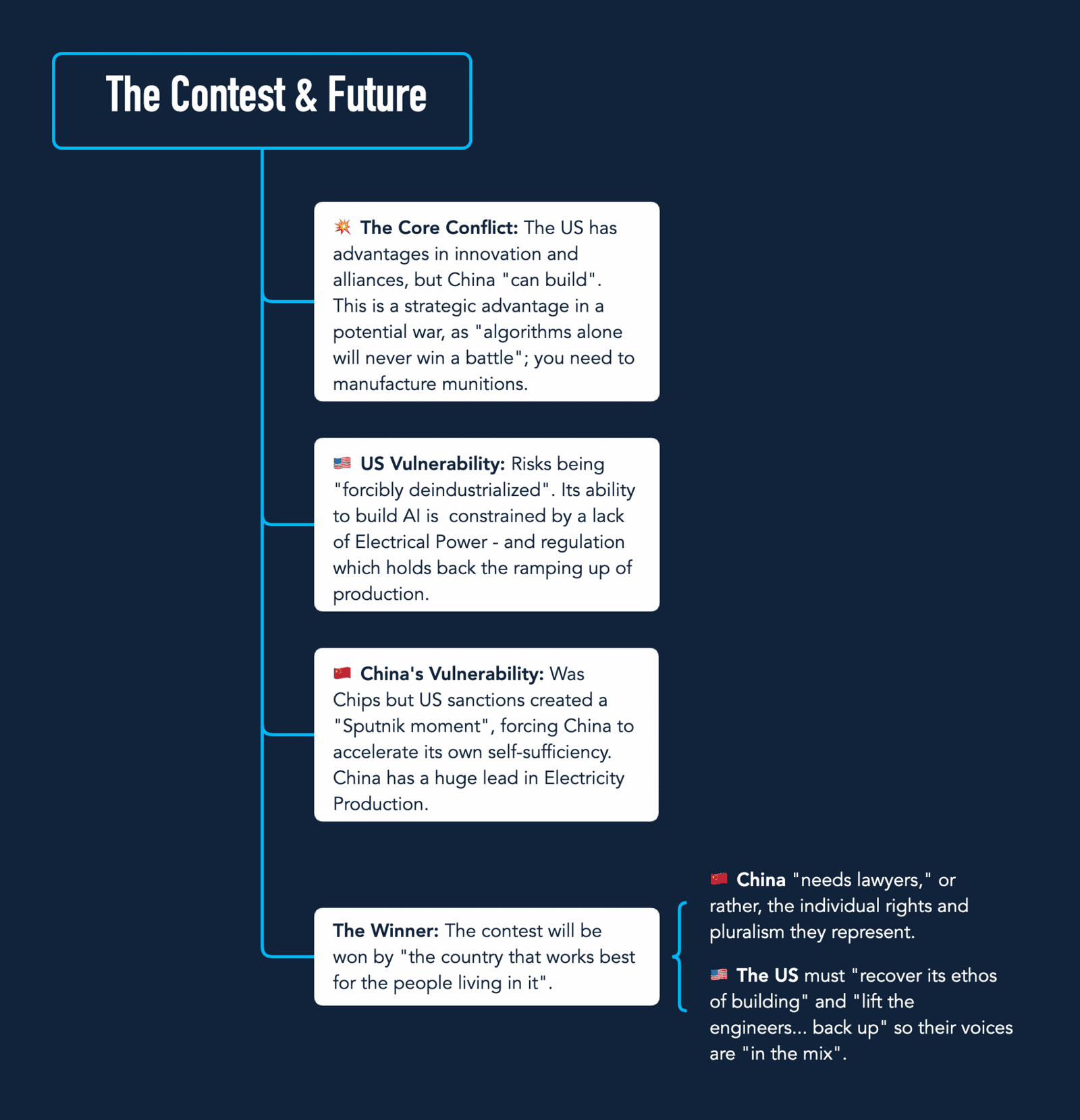
The contest and the future.
The future would seem to come down to: The US has the edge in innovation, but China can build.
“The United States has immense advantages over China: robust economic growth, an expanding and more youthful population, innovation in digital technologies, a larger network of alliances, and more. But we need to recognize that the engineering state has a giant advantage: China can build. That will matter if the two countries ever decide, in an apocalyptic scenario, to go to war. No military can be powered by artificial intelligence alone; it will need drones and munitions. And the engineering state is better set up to produce these in overwhelming quantity.”
Dan Wang
Perhaps this is over-simplistic as China is also demonstrating innovation across all sectors now – but it’s certainly true that there needs to be a sea change in geopolitical and economic thinking in the West to recover the ethos of building and retrain a new generation of engineers.
Dan concludes that ‘the winner’ will be the country that “works best for the people living in it.” Whilst that may be true, the path for China remains complex. It needs lawyers, or at least stronger individual rights and the pluralism they result in. Without this Chinese private capital will continue to gravitate overseas in search of safe harbour.