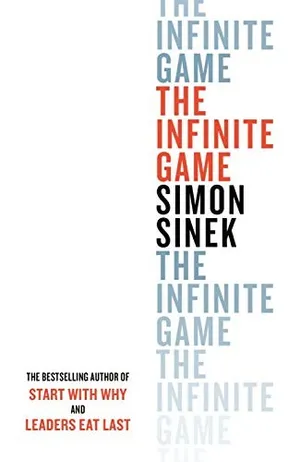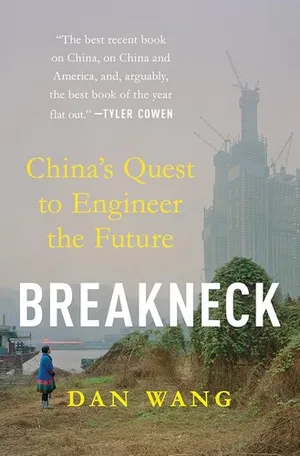
About This Article: Like other entries in my Notes from the Book series, I wrote this primarily for myself. These notes serve as an online journal, where writing helps me learn and publishing sharpens my thoughts while creating an accessible reference. Expect longer quotations, drawn directly from my Kindle highlights, as I aim to capture key insights. Learn more about my workflow for syncing these notes here.
I started reading Simon Sinek’s The Infinite Game based on a sharp observation from venture capitalist Bill Gurley. He noted that everyone, from journalists to tech leaders, is framing the current US-China AI rivalry as the “AI Wars” or the “AI Race”. His point was simple: these framings are fundamentally incorrect. It’s not a war or a race – it’s an infinite game.
Bill Gurley: Almost everyone in the AI space that I see with a microphone in front of them says the U.S. has to win the AI war…. Yeah, I don’t know what that means… And if, I guess as to what it means, I don’t think it’s possible, Right.
Brad Gerstner: Because it’s an infinite game?
Bill Gurley: It’s an infinite game. And no one that I talked to would argue we’re going to somehow prohibit them from moving forward in AI. Let’s not forget, it wasn’t that long ago that OpenAI, they’ll say borrowed, or copied the innovation that happened at Google… Like, this is how innovation works.
Infinite Games v Finite Games
Sinek’s thesis is simple – our world is filled with two types of games:
- Finite games are played by known players with fixed rules and an agreed-upon objective. There is a clear winner and loser, like in football or chess.
- Infinite games, in contrast, are played by known and unknown players, the rules are changeable, and there is no finish line. The objective is not to “win,” but simply to keep playing—to perpetuate the game. Business, politics, and life itself are all infinite games.
Sinek writes, “there is no such thing as winning global politics.” Players simply drop out when they “run out of the will and resources to keep playing.”
The central problem Sinek identifies is that too many leaders are playing an infinite game with a finite mindset.
“When we lead with a finite mindset in an infinite game, it leads to all kinds of problems, the most common of which include the decline of trust, cooperation and innovation. Leading with an infinite mindset in an infinite game, in contrast, really does move us in a better direction. Groups that adopt an infinite mindset enjoy vastly higher levels of trust, cooperation and innovation and all the subsequent benefits.”
Simon Sinek
The “AI Race” – and why this framing gets it wrong
This brings us back to the “AI Race.” Framing the US-China rivalry as a finite game (with a finish line like “winning” or “first to AGI”) forces a zero-sum mentality. This is the exact strategic trap that Sinek warns against, and recent events suggest the consequences are already unfolding.
In Breakneck 1, (another book I’m reading), Dan Wang discusses how US sanctions/export controls on Huawei created a “Sputnik moment” for China, forcing it to develop its own chip industry. I.e. the mistake was to assume that restricting the supply of chips would help the US ‘win the AI Race’ / force China out of it.
Nvidia’s CEO, Jensen Huang, last week suggested this finite-minded policy has escalated into a “Sputnik moment on steroids” for China – and calls it “the dumbest thing we’ve ever done,” giving China “the best national mobilisation mission in 50 years”. He highlights China’s determination (“The more you sanction them the harder they work”) and their sheer scale (“one million people working on this 24/7… we have maybe 20,000”).
“Washington thinks they’re stopping China. They’re not stopping China — they’re accelerating China. By 2027, China will have more AI compute than the rest of the world combined.”
Jensen Huang
(Although Jensen’s framing in an interview with the FT that “China is going to win the AI race” was unfortunate).
So what should the West do instead?
The goal isn’t for the US (or Europe if it ever wakes up) to “beat” China. The goal is to build a nation and innovation ecosystem “strong enough and healthy enough to stay in the game” for decades.
To counter this trap, Sinek offers several practices, but two are most critical in this context: advancing a “Just Cause” and studying your “Worthy Rivals.”
1. Advance a Just Cause
A Just Cause is a specific vision of a future state that does not yet exist; a future state so appealing that people are willing to make sacrifices in order to help advance toward that vision.
Simon Sinek
I.e. rather than framing as “winning the AI Race” – the US Administration and business leaders should be looking to push a Just Cause such as “accelerate and shape AI innovation to help advance the pursuit of Liberty and Happiness” – or words to that effect.
Incidentally this may also help with US domestic opinion which has turned negative on AI: – 77% of respondents to the Reuters/Ipsos poll said they worried the technology could be used to stir up political chaos, and 71% fear AI causing permanent job losses. It’s becoming politically challenging to openly voice support for AI acceleration.
2. Treat other players as a Worthy Rival
If we are a player in an infinite game, however, we have to stop thinking of other players as competitors to be beaten and start thinking of them as Worthy Rivals who can help us become better players.
Simon Sinek
Other nations / AI Labs are not competitors to be beaten, but “Worthy Rivals” who reveal your own weaknesses and force you to improve. An infinite-minded leader looks at China’s lead in OpenSource LLMs (most recently MiniMax-M2) and sees opportunities to make big advances with far less capital and less performant chips2.
Similarly, policymakers might look at China’s advances in Solar and Nuclear and consider what structure inefficiencies exist in their markets which are causing energy bottlenecks3.
Other examples of where I see finite thinking in Infinite games
Ultimately, the concept of The Infinite Game provides a critical reminder that the “AI Wars” or “AI Race” framing is a strategic trap – and leads to policy decisions 180 degrees from what would be optimal. The real objective isn’t to Win the AI race, but to build a nation that has the will and resources to keep playing the infinite game of innovation and technological advancement.
This framework, once you see it, applies everywhere.
It’s in the political debate over wealth. “Tax the rich” is often proposed as a finite, ‘winnable’ solution to plug budget gaps created by government waste and productivity gaps. But the game of a national economy is infinite. As is being debated in the UK, if leaders (like Rachel Reeves) push this finite move too hard to “win” a budget shortfall, the ‘rich’ – can simply ‘up sticks’ and leave. And they are. The system, having lost their resources and entrepreneurial spirit, is then less able to keep playing.
It’s in the corporate short-termism I see (including at times in my own organisation), with whipsaw pivots driven by weekly metrics rather than a long-term ‘Just Cause’. It’s in the obsession with ‘staff utilisation’ instead of skills enhancement and ‘staff productivity’. And it’s in the finite-minded logic that cuts investment in people, overlooking the massive long-term costs of hiring, retraining, and lost morale.
It’s even in our personal lives. The finite mindset sees education as a game to be ‘won’ at university by getting a certificate. The infinite mindset understands that true learning is a game that never ends – and that the most valuable books are often the ones that have stood the test of time, but perhaps were not taught in classrooms.
“We do not study for life, but only for the lecture room” (non vitae, sed scolae discimus).
Seneca
And bringing it all back to AI, while the finite-minded business leader is paralysed, asking, “How will AI disrupt my business?”, the infinite-minded leader is mobilised, asking, “How will AI help me become more productive, add more value to my clients, and better advance my Cause?”