5 Ws of Communication

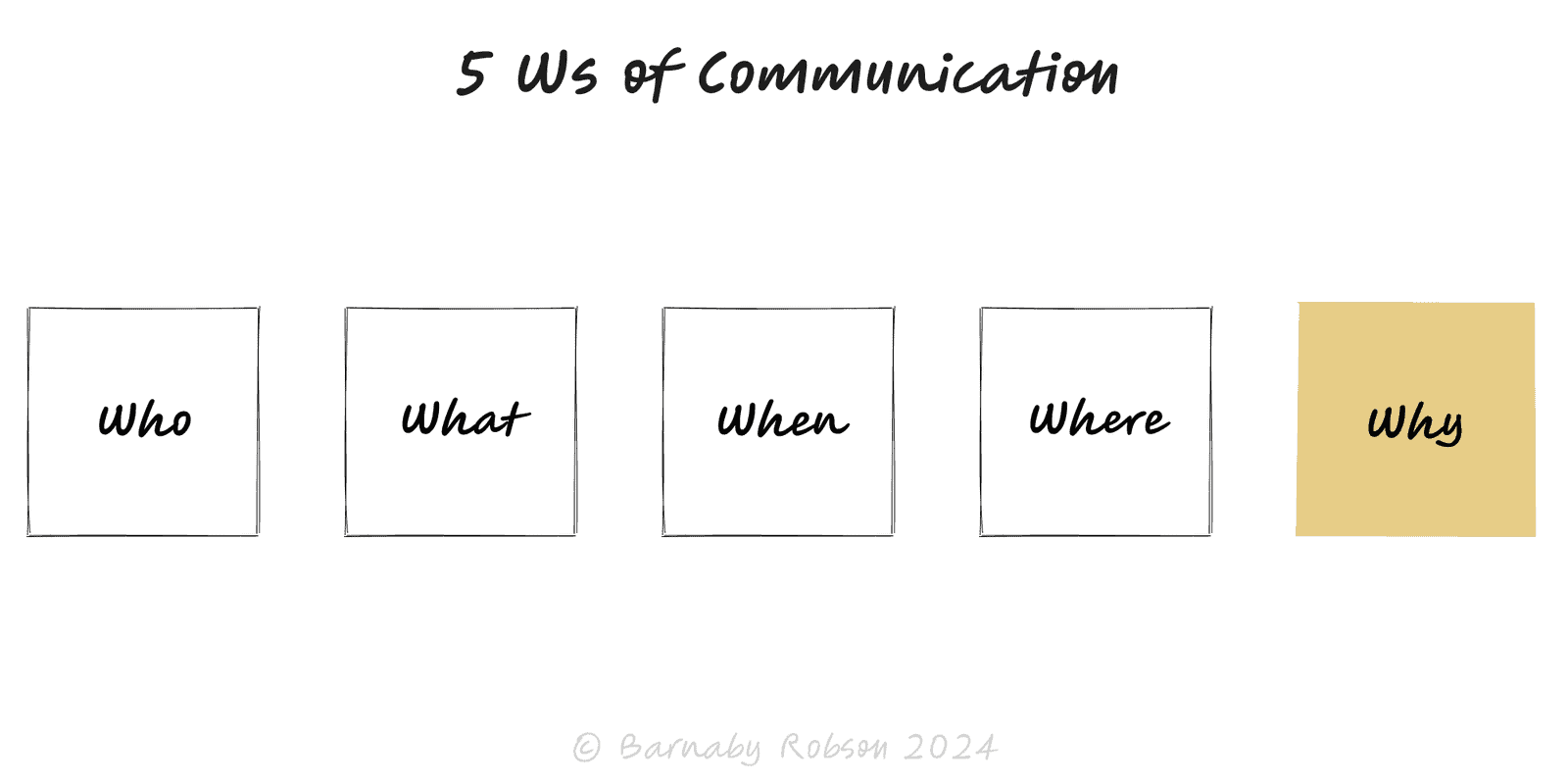
A compact briefing frame that forces concretes: Who, What, When, Where, Why (and How). Use it to make messages decision-ready and prevent gaps that derail execution.

Author

Journalism and classical rhetoric (5W1H tradition)


A compact briefing frame that forces concretes: Who, What, When, Where, Why (and How). Use it to make messages decision-ready and prevent gaps that derail execution.

How it works


Who – the owner, stakeholders, affected audiences, and approvers (with single-point ownership).

What – the concrete deliverable or action, including scope boundaries and success criteria.

When – deadlines, cadence, milestones, timeboxes, SLAs; include timezone if relevant.

Where – the location or environment: market, channel, repo, URL, venue, environment (dev/stage/prod).

Why – the reason, objective, or bet; link to a metric or outcome and the decision being accelerated.

How (optional) – the chosen approach, constraints, resources, and key risks/assumptions.
Use-cases


Kick-off briefs for projects, campaigns, or experiments.

Decision memos that need quick approval with minimal back-and-forth.

Handoffs between functions (product ↔ engineering, sales ↔ marketing).

Incident comms and stakeholder updates where speed and clarity matter.

Pitfalls & Cautions


Vague nouns and verbs – “improve”, “ASAP”, “support” create divergent interpretations.

Skipping Why – without the reason and metric, teams optimise the wrong thing.

Hidden constraints – unspoken dependencies surface late; put them in How or Where.

No owner – multiple “owners” means no owner; name one DRI and escalation path.

Order bias – starting with How can lock you into a poor plan; start with Why/What unless it’s an emergency.

Recent Mental Models

Click below to learn other mental models

  • The Idea Maze

    The Idea Maze

    Before building, map the space: the key forks, dead ends and dependencies—so you can choose a promising path and run smarter tests.

  • Thucydides Trap

    Thucydides Trap

    When a rising power threatens to displace a ruling power, fear and miscalculation can tip competition into conflict unless incentives and guardrails are redesigned.

  • Zero to One

    Zero to One

    Aim for vertical progress—create something truly new (0 → 1), not just more of the same (1 → n). Win by building a monopoly on a focused niche and compounding from there.